A Sermon from June 25, 2023
I’m a guy that loves a good holiday and try to leave no holiday un-celebrated, but I’m still learning how to celebrate Juneteenth. I think many of us are, especially white folks, in part because some of us are still learning what Juneteenth commemorates in the first place.
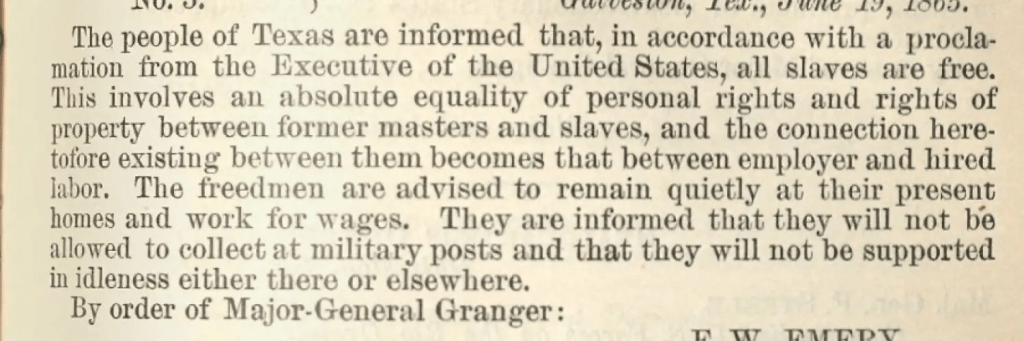
One historian tells it this way, “For most enslaved people in Texas, June 19, 1865 was a typical day. They got up, they went to the fields… working just as they always had done. This was two months after the Civil War ended and two and a half years after the Emancipation Proclamation issued on January 1, 1863. Although their emancipation had already been proclaimed, enslaved people in Texas were not yet living in freedom. But, on that day, June 19, General Gordon Grainger of the Union Army galloped into Galveston with the news. ‘The people of Texas are informed that in accordance with a President Lincoln’s Emancipation Proclamation, all slaves are now free.’” (Dr. Daina Ramey Berry, The Daily, June 19, 2020)
By executive proclamation, these enslaved Black Texans had been free for two and half years, but that good news hadn’t reached them. Can you imagine? Juneteenth commemorates the day this gospel finally reached them, emancipating them (along with their enslavers) to live new, free, lives.
By Romans 6 Paul has made a bit of a mess for himself. For 5 chapters, with the broadest of brush strokes, Paul has graffitied the gospel across all these little Roman house churches. “While you were yet sinners, Christ died for you. And now, because of that, I proclaim to you in the name of Jesus Christ, the lot of you, are free from Sin and Death.”
By proclaiming the complete and absolute remission of the sins of Gentile and Jew alike through Christ’s work on the cross, Paul has more than hinted at the abolition of the Law of Moses, and the emancipation of all sinners. In so doing he makes a mess, a scandal.
Confused, the newly freed start asking “What are you saying Paul? That we’re no longer bound by God’s Law? If God’s grace is greater than all our sin, does that mean we sin all the more so that grace may abound?” (We have evidence that there were some among them who were actually arguing for this, and even trying it out a bit).
“No,” says Paul, “By no means! That’s not how emancipation works! Having been freed from Sin, it makes no more sense for you to go back to sinning than for an emancipated slave to willingly re-enter slavery.”
“Having once been slaves of sin, now set free, you have become slaves of Righteousness. For just as you once presented yourselves as slaves to Sin, and to greater and greater iniquity, so now present yourselves as slaves to Christ for sanctification. The destination, (the wages, the telos) of Sin is Death, but the free gift of God is freedom: the freedom to journey toward a new destination, toward abundant and eternal life in Christ Jesus our Lord.”

In his book Unapologetic, author Francis Spufford describes what Paul here calls being “slaves to Sin” as the “Human Propensity to Muck Thinks Up” (only he spells “Muck” with an “F”). In explaining his point he recalls a story about John Newton, the author of the hymn “Amazing Grace.”
Spufford reminds us that Newton, a self-described “wretch” saved by grace, was in fact far worse than a wretch. Newton was a slave trader. His livelihood was kidnapping and transporting human lives and bodies “in conditions of great squalor and suffering, to places where they and their children would be treated all their lives as objects to be bought and sold and brutalized… Wretch? More than,” says Spufford, “John Newton was a horror.”
But somehow, by Amazing Grace alone, the good news of the complete and absolute remission of his Sin reached even John Newton’s ears. He had an experience of salvation, conversion, and in the rapturous ecstasy of a grave sinner being forgiven, he wrote this famous hymn,
“Amazing grace how sweet that sound that saved a wretch like me. I once was lost but now am found, was blind but now I see!”
But there is a wrinkle in this story, Spufford writes, “The wrinkle is that [Newton] wrote that line before he gave up the slave trade.” It would be years after his experience of God’s Amazing Grace until Newton would realize that the Grace that emancipated him from sin also demanded he emancipate his own slaves.

Do you see the parallel here? Juneteenth commemorates the proclamation of a gospel that had been true for years but was only now being realized. Likewise, Newton’s own eventual renunciation of slavery, his work for the abolition of slavery, his sanctification, was a years-after-the-fact repentance toward a truth that had been true all along.
It had been true. All along. He was free from Sin. He had been since his baptism. He just didn’t know it. And certainly didn’t know the extent of it.
We know from African American Spirituals, and the stories of slave churches meeting in upper rooms and brush arbors, that enslaved Christians knew this gospel all along. Juneteenth commemorates the news of their legal freedom, but they’d always known they were free. What it took (and is still taking) was for the rest of the world to catch up, for the gospel of freedom and reconciliation to reach their ears, and our hearts.
One of those Spirituals, Oh Freedom, includes the line “And before I’ll be a slave I’ll be buried in my grave, and go home to my Lord and be free.”

The Apostle Paul pushes this proclamation even further saying, you have already been buried in your grave, and his name is Jesus. Your Sin, your slavery, your bondage to the powers of Sin and Death have been put to death in Christ. Your baptism testifies to this. “Whoever has died with him, he will also raise to freedom.”
In the name of Jesus Christ the worst thing you have ever done, along with the worst thing ever done to you, all of it has been buried with Christ and is now being raised. Your slavery and your sin have died. You are forgiven, you are reconciled, you are free.
So what of adherence to the Law? Remembering the Sabbath? Loving your neighbor? Renouncing evil, injustice, and oppression? In Christ we see that these are not the commands of a slavemaster, handed down to bind our freedom, they are given to emancipate us to live in the faith that really is freedom. Sinners like us, saved by Grace, whenever we manage to repent of any sin we do it not for shame, but in freedom, as those who have died to sin and been raised to new life in Christ.
“Therefore,” Paul says, “if we have died with him, let us live with him in freedom.”
In the film called Amazing Grace which tells the story of the abolition of slavery in England John Newton makes an appearance, but there is another scene which gripped me. In this scene a mixed race congregation is singing Amazing Grace, and I swear you can see a black woman in the crowd who instead of singing “was blind but now I see,” sings “but now I’m free.”
Hear the good news. You are free. Descendants of the enslaved, and descendants of the enslavers. In the name of Jesus Christ you have been emancipated from the powers of this world, and the sin and shame of your own heart. It no longer has a hold on you. It has been put to death in Christ and the life we live we now live to God. May God grant us grace to believe in this freedom, and through believing, to live it.
 dvcolby.com