There are a few things I do every November. One is to rake leaves for the kids (and me) to jump in. Another is to cue up my November playlist (all songs related to thanksgiving and food). A third is to watch one of my favorite fall movies, Dead Poets Society.
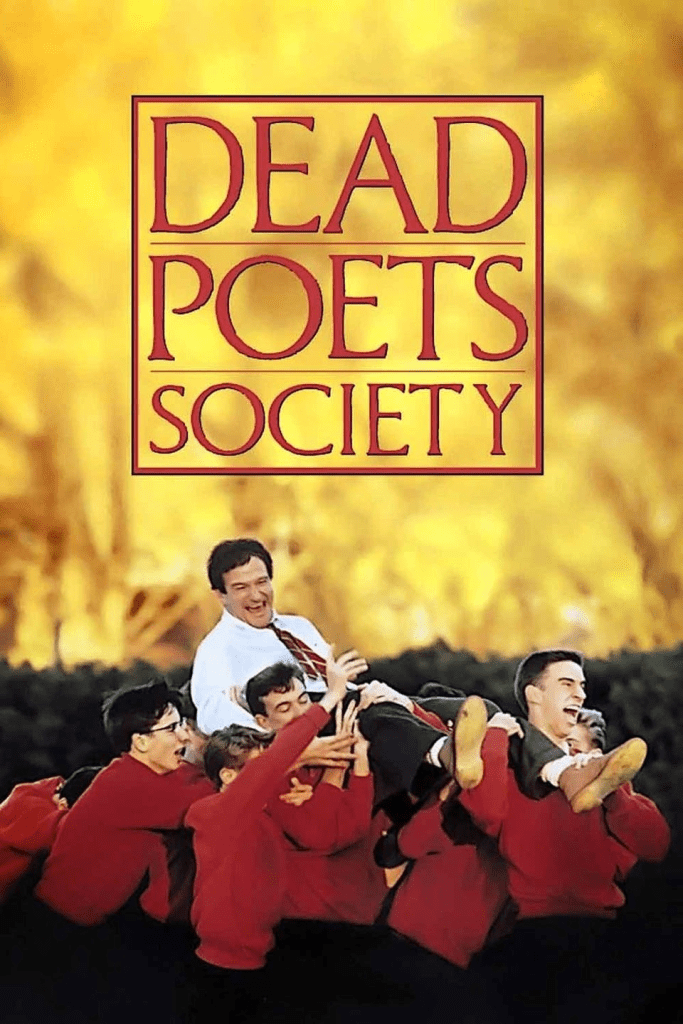
Set in a New England prep school in Autumn, the film opens with a mural of past students of Wellton Preparatory School, which some students affectionately call “Hell-ton.” The camera pans down to a young man, no older than 10, being dressed by his mother for convocation. He’s got a small cap on, struggling to keep a lid on the boy’s youth, as his mother tightens his tie so tight that he winces. Then a single candle is lighted as we overhear strict instructions being whispered, “You will light the candle of the headmaster and then the headmaster will light the candles of the boys.”
The procession begins with the school’s four pillars stitched on big banners: Tradition, Honor, Discipline, Excellence. The Headmaster’s opening remarks include a litany of last year’s statistics: 51 graduates, 75% of which went on to the Ivy Leagues. “This accomplishment,” he says, “is the result of the fervent dedication to the principles taught here.” All the parents applaud.
The headmaster then informs the crowd that there’s a new English teacher this year, himself a graduate of Hell-ton, Mr. John Keating, played by Robin Williams.
A couple scenes later we are in Mr. Keating’s class. As he enters the room the boys fall silent, sit up straight, and center their textbooks on their desks. But Keating walks right past them, straight from his office to the back door, whistling the 1812 Overture conjuring the bombs he’s about to drop on them to blow their young minds open. He gets to the door, turns around and says to his class “Well come on!”
Keating knows well the four pillars of his alma mater, Tradition, Honor, Discipline, Excellence, but by the end of his first unorthodox lecture he has declared his own pillars: Poetry, Beauty, Romance, and Love.
“We are food for worms, lads,” he tells them. “Believe it or not, every one of us in this room is going to one day stop breathing, turn cold, and die.” He invites them then to lean in close as he quotes Walt Whitman to them, “Gather ye rosebuds while ye may.” Then he whispers, “Carpe…. Carpe diem.” Seize the day.

In today’s parable it is not four pillars that get handed down from headmaster to student, nor the light of knowledge, it’s money, lots and lots of money.
A talent is somewhere between one and five years wages, so when this master doles out five talents to one slave, two talents to a second, and one to a third, he’s effectively handed them a bajillion dollars. And then he goes away.
Traditionally this is understood to be a parable about Jesus, he is like the master who lavishes his servants, his disciples, with grace upon grace, the treasures of God which are his property entrusted to his disciples like priceless pearls cast before swine. And then he goes away, promising to return unannounced to see what has come of his investment.
The implication is of a final coming judgment, a harvest, a settling of accounts, a day that is coming when the world will be made right, the righteous told “well done, good and faithful servant,” and the unrighteous told “hit the road Jack.” The promise is that God’s purpose for creation, revealed in Christ, will in the end be fulfilled. God is going to get what God wants, and God will be the judge of whether we servants are indeed wanted or allowed to enter eternity.
But it begs the question, what is it that God wants? What is God’s purpose for creation? What are the terms of God’s judgment?
Some have always said the terms are a lot like the four pillars of Hell-ton: Tradition, Honor, Discipline, Excellence. But the thing is, when Jesus shows up he doesn’t really seem to embody any of these.

He’s not very traditional. He eats and heals on the Sabbath.
He’s not very honorable, he associates with tax collectors and sinners.
He’s not very disciplined, he’s accused of being a drunkard.
And he certainly doesn’t meet any existing standard of religious or political excellence. He’s a failure. He dies a religious heretic, and a political loser.
It’s not that tradition, honor, discipline, and excellence are bad. It just appears that what God is up to in Jesus Christ is something different. Jesus is clear, this is going somewhere, and there is a real expectation of God’s judgment in the end. He is coming back to judge the quick and the dead, but what is he judging?

In subsequent scenes of the movie Keating’s unorthodox methods never cease to thrill. He has the boys rip out the whole introduction of their textbook, has them stand on a desk to gain a new perspective, has them shout poetry on the soccer pitch, and sound their barbaric “Yawp.”
We learn that Keating was once a member of a secret society at the school, the titular Dead Poets Society, which the boys resurrect in a hidden cave out in the woods. Passing out their contraband, of cigarettes, centerfolds, and chocolate chip cookies, they start each meeting with a quote from Thoreau, “I went to the woods because I wished to live deliberately. I wanted to live deep and suck out all the marrow of life!”

In the parable, upon receiving this lavish gift from their master, the first two slaves decide to actually do something with it. They risk it, use it, live with it, and it multiplies.
This is not some biblical endorsement of venture capitalism. Far from it.
This is an example of living deliberately, sucking the marrow out of life. But the third slave seems so obsessed with not risking running afoul of the (Head)Master that he’s paralyzed. Unable to enjoy the gift given to him even for himself, let alone share it with others for fear of the strings that he assumes are attached to this gift. So instead he buries his talent, and lives out his days weeping in fear of the Lord’s return, gnashing his teeth in anxiety over his master who he believes is coming to judge him, harshly.
When the master comes, the first two slaves are honored and welcomed by the master “Well done, good and faithful servant.” But when the master reaches the third servant he hears a weepy confession, “I knew you were going to be harsh with me, Lord. I knew you were judgmental to a fault, and so I hid your money. Here, you can have it back.”
“You knew I was harsh, did you? Well, if all you believe there is for you in this life is weeping and gnashing of teeth, then all you’ll get is weeping in the gnashing of teeth. Come back when you are ready to…” what did he call it with the other two servants? Oh yeah, “Come back when you’re ready to enter into the joy of your master.”
So often when the church ponders the final judgment, we’ve emphasized the fear of the Lord to a fault. This parable is not a warning intended to incite fear in your heart. It is a promise intended to make you ready for heaven. See, heaven? It appears that what heaven is is all joy. To enter heaven will be to enter into the joy of our Master, the joy that is our Master.
In this light we see that what got Jesus killed is his apparent lack of fear of the Lord, a lack of the tradition, honor, discipline, and excellence that we expected to find in a savior. Instead he was all love, all joy, but we weren’t ready.
But now we know. If we want to be ready for heaven, we are wise to start growing more accustomed to joy. Can you believe that? It’s more than a figure of speech, it’s an honest question, can you believe that?

In the end the collision of Keating’s poetry, beauty, romance, and love with the ways of Wellton land on Keating’s own head. In the wake of a tragedy for which his teaching is blamed, Keating is relieved of his position. But in the movie’s final scene, as he is being escorted from his classroom, his students, though not all of them, stand on their desks, their heads level with the classroom’s own light, and they pledge their allegiance to him, “O Captain, my Captain.”
Because of Keating, in a world that is passing away, the perspective and posture of these young men has been forever changed. For them life is more than wealth, prosperity, and the Ivy League. For them it’s Carpe Diem – seize the day.

For us Christians living not in a movie, but never the less in a world that is passing away, our invitation is even bolder than that. It’s not Carpe Diem, it’s Carpe Deus. Seize the Lord, seize the joy of your Master, sink your teeth into the joy of the gospel, make it your business, do your daily dealing in the grace of God.
Thoreau says “suck out the marrow of life,” Jesus says “Take and eat! This is my body.” Carpe Deus. Seize the Lord. Live the kind of life God lives. Love what God loves. Tell stories. Write poetry. Throw parties. Give gifts. Enjoy your forgiveness. Trust it. Believe it. Invest it. Waste it.

Because under this (Head)Master the one who tries to bury or preserve their life will lose it. It’s the one who wastes their life on the things of God who will gain it. Our Master has given us great gifts, and with them the authority to bind and to loose, so let it loose!
And hear the good news. The Lord is here, and the Lord is coming back. And when he does, he will come to judge. He intends to welcome you into heaven; but not all of you. Your fear may not come. Your excellence too must be left at the door along with your sin, and all death. What he wants to see when he returns, what he plans to get out of you is joy. Carpe Deus. Seize the Lord, and prepare to enter into the Joy of your Master.
 dvcolby.com